Precision Weave Types for Filtration and Separation
Selecting the optimal wire mesh weave pattern directly governs particle retention accuracy, differential pressure tolerance, mechanical fatigue resistance, and throughput capacity. Review our standard and specialized industrial stainless steel weave geometries below.
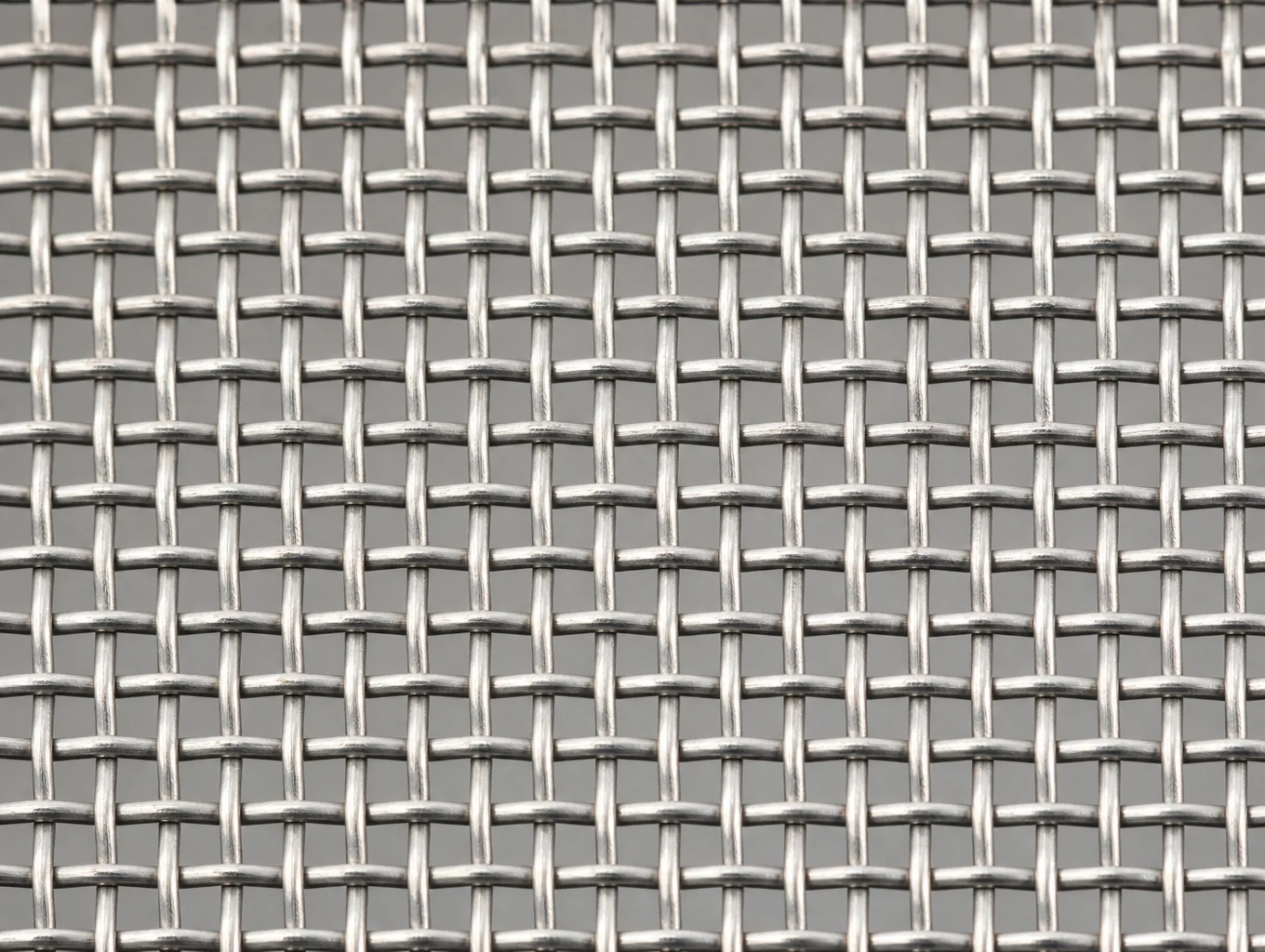
General particle sizing, sieve analysis, liquid screening, and architectural mesh.
Plain Square Weave Structure
Basic 1:1 over-and-under pattern producing stable, square apertures with maximum open area.
Key Engineering Advantages
Weave Pattern Specification & Performance Comparison
Compare differential pressure, retention thresholds, and cleaning suitability across standard industrial alloys.
| Weave Structure | Pore Geometry | Filtration Rating | Pressure Drop | Cleanability | Flow Efficiency | Standard Material Alloys |
|---|---|---|---|---|---|---|
| Plain Square | Square Direct | 25 – 5000 µm | Very Low | Optimal (Surface) | 95% | 304 / 316L / 310S |
| Twilled Square | Square Direct | 20 – 250 µm | Low | Very Good | 85% | 316L / 904L / Alloy 20 |
| Plain Dutch | Triangular / Wedge | 10 – 300 µm | Moderate | Good (Backflush) | 75% | 316L / Hastelloy C276 |
| Twilled Dutch | Tortuous Micro-Path | 1 – 80 µm | Moderate to High | Ultrasonic / Solvent | 60% | 316L / Monel 400 / Inconel |
| Reverse Dutch (PZ) | Chevron Interlock | 40 – 400 µm | Low to Moderate | Continuous Auto-Advance | 80% | 304L / 316L High-Tensile |
Precision Metallurgical Testing & Certification
Every weave batch is verified for wire diameter tolerance, aperture uniformity, tensile integrity, and alloy chemical composition per ASTM E2016 and ISO 9044 standards. Material test reports (EN 10204 3.1) are supplied with all shipments.
Industrial Weave Comparison Matrix
Compare structural characteristics, retention limits, mechanical endurance, and operational suitability across standard square and precision Dutch weave geometries.
| Weave Pattern | Retention (Microns) | Mesh Count Range | Internal Structure | Mechanical Strength | Permeability | Recommended Applications |
|---|---|---|---|---|---|---|
Plain Square WeaveSS304, SS316L, SS310, Monel 400 | 25 µm – 5,000 µm | 2 – 500 Mesh | 1:1 over-and-under pattern with identical warp and weft counts | Moderate | High | General sizing, dry screening, hydraulic intake straining |
Twill Square WeaveSS304L, SS316L, 904L, Hastelloy C276 | 20 µm – 250 µm | 150 – 635 Mesh | 2:2 crossing pattern allowing heavier wire at fine mesh counts | High | Medium | Fine powder classification, pharmaceutical sieving, fluid beds |
Plain Dutch WeaveSS304, SS316L, Nickel 200, Inconel 600 | 10 µm – 300 µm | 12×64 – 80×700 Mesh | Coarse warp wires packed tightly with high-density fine weft wires | High | Medium | Centrifuge baskets, pressure leaf filters, fuel filtration |
Twilled Dutch WeaveSS316L, Titanium Gr1/Gr2, 904L, Alloy 20 | 1 µm – 100 µm | 20×250 – 500×3500 Mesh | Twill pattern with dense dual-layer weft packing for micro-openings | Ultra-High | Controlled | Aerospace hydraulics, sterile gas vents, chemical micro-slurry |
Reverse Dutch Weave (PZ)SS304, SS316, High-Tensile Carbon Steel | 40 µm – 200 µm | 48×10 – 152×24 Mesh | High-density heavy warp wires with thin spaced weft wires | Ultra-High | Controlled | Continuous auto-screen polymer changers, high-pressure extrusion |
Broad Mesh / Optimized FlowSS316L, Duplex 2205, Super Duplex 2507 | 5 µm – 150 µm | Custom Calibrated | Geometric opening channels designed to reduce differential pressure | High | High | High-viscosity polymer melts, ballast water treatment, subsea valves |
Engineering Selection Guidelines
Need custom mesh calculation or non-standard weave geometry?
MutualFilter engineers provide flow rate calculations, micron retention verification, and customized slitting or stamping for industrial equipment manufacturers.
Request an Industrial Wire Mesh Quotation
Direct factory pricing, custom slit coils, fabricated filter elements, and technical validation for OEMs, distributors, and process engineers worldwide.
Request for Quote (RFQ)
Fill out your requirements below for rapid technical and commercial assessment.
What Happens Next?
Our structured process ensures accuracy from drawing to delivery.
Specification Review
Our filtration mesh engineers review your alloy, mesh count, wire diameter, and opening size requirements.
Formal Quotation & Data Sheet
Receive comprehensive pricing, material test certificate (MTC) availability, lead times, and MOQ terms.
Sample or Batch Production
Verification samples or custom precision slitting/stamping orders proceed with stringent ISO 9001 QA inspection.
Need Custom Slitting or CAD Drawings?
Our team can assist with mesh micron-to-mesh conversion, custom tooling, and bespoke pleat packs.