Industrial Applications

Polymer & Plastics Filtration Solutions

Precision woven wire mesh filter packs, sintered laminates, and continuous screen changer belts engineered for high melt viscosity, elevated operating temperatures, and severe process pressures.

High Mechanical Rigidity
Multi-layered woven and sintered stainless steel matrices resist deflection and blowout under extreme melt pressure up to 250 bar.
Thermal Stability to 400°C
Maintains absolute structural integrity and uniform pore geometry across high-temperature engineering resins (PEEK, PTFE, PPS, PA66).
Exact Pore Size Control
Precision-calibrated Dutch and twilled weaves ensure defined cut-off points to trap unmelted gels, carbon specks, and particulate contaminants.
Extended On-Stream Life
Graded pore designs maximize contaminant retention capacity, drastically reducing costly extruder downtime for filter pack changes.

Application Fields & Filter Media Design

Select an industrial polymer sector to explore specialized mesh configurations, pressure envelopes, and design specifications.

Continuous Polymer Melt Extrusion Filtration

Engineered multi-layer wire mesh packs and continuous screen changers designed to withstand differential pressures exceeding 200 bar and melt temperatures up to 350°C.

Filtration Rating5 μm to 250 μm
Max Differential PressureUp to 250 bar
Operating TemperatureUp to 400°C
Standard AlloyAISI 304L / 316L
Technical Highlights
Rigid multi-layer spot welded or framed disc construction
Low polymer retention time reducing degradation and carbonization
High mechanical resistance preventing screen rupture under viscous flow
Custom outer diameters from 20 mm to 600 mm
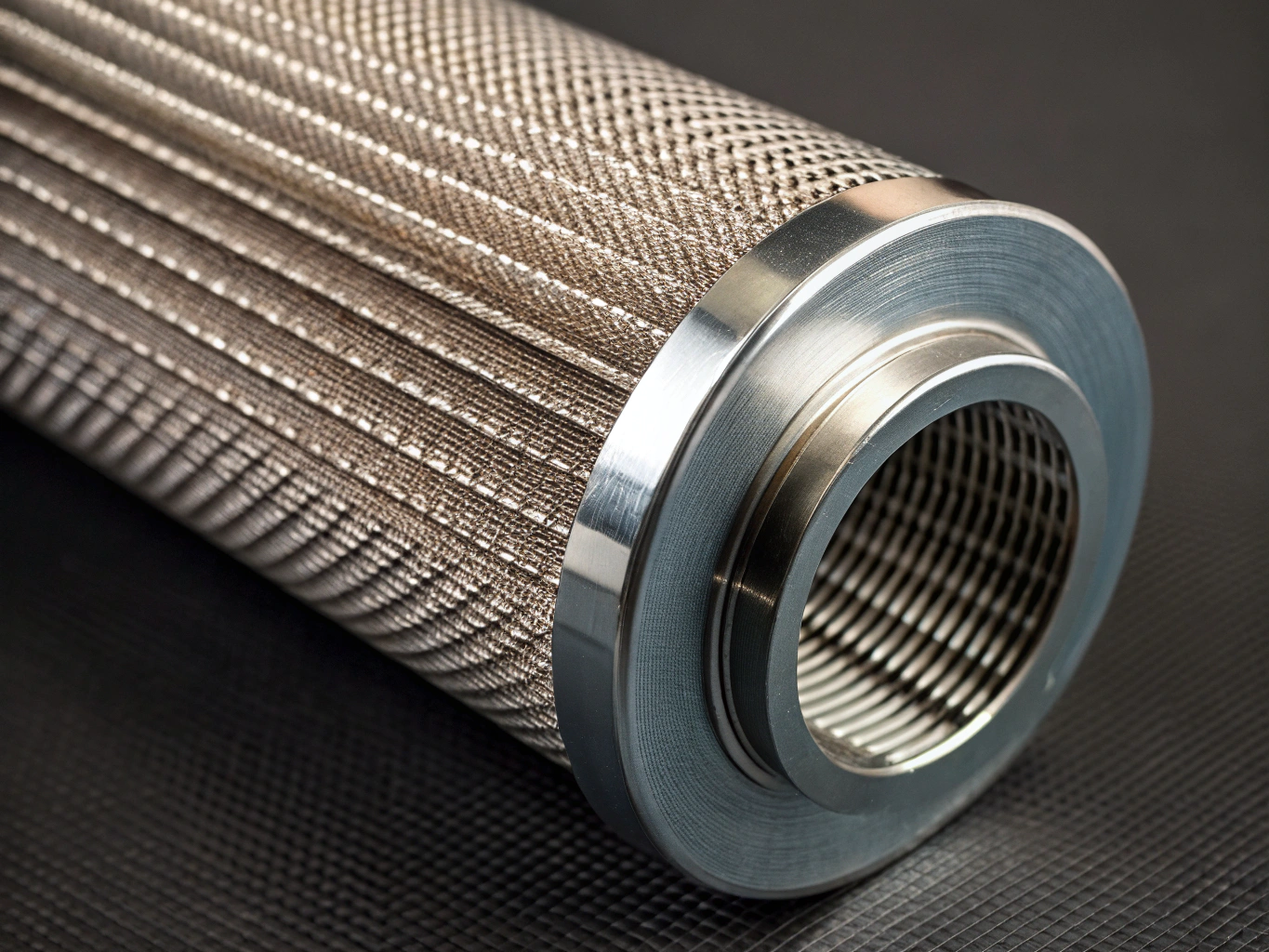
Stainless steel polymer melt filter mesh disc
Alloy: AISI 316LInspection: ISO 9001

Resin Family & Filter Media Selection Matrix

Recommended standard wire mesh weave patterns by target polymer chemistry.

View Material Grade Sheet
Polymer GroupRecommended Filter WeaveStandard Micron RangeInquiry
Polyolefins (PP / PE / HDPE / LDPE)Plain Dutch / Reverse Dutch25 – 150 μmQuote Pack
Polyester & Polyamides (PET / PA6 / PA66)Sintered Multi-Layer / Twilled Dutch5 – 40 μmQuote Pack
Recycled Plastics (rPET / rHDPE / PCR)Heavy Reverse Dutch / Multi-Disc50 – 300 μmQuote Pack
Engineering Polymers (POM / PBT / PC / PEEK)Sintered Fiber Felt / 316L Wire Mesh10 – 60 μmQuote Pack

Custom Melt Filter Pack Fabrication

Spot welded multi-layer packs, framed discs, kidney packs, and auto-screen roll belts custom fabricated to OEM extruder drawings.

Talk to an Engineer
Engineering Specifications

Polymer Melt Filtration Technical Data & Plant Benchmarks

Validated wire mesh specifications, differential pressure tolerances, and operational data for demanding high-temperature polymer extrusion, fiber spinning, and recycling processes.

Benchmark #1
99.82%

Gel Retention Efficiency

Validated at high melt index processing (285°C, 310 bar)

Benchmark #2
+42%

On-Stream Screen Life

Extended continuous run time before automatic indexing

Benchmark #3
< 1.2 bar

Clean Pressure Differential

Minimal initial ΔP resistance through woven wire geometries

Benchmark #4
450°C

Thermal Stability Threshold

Continuous operating limits without structural fatigue

Alloy & Weave Performance Matrices

Select polymer processing application to inspect micron retention, burst limits, and wire specifications.

Nominal RatingAbsolute Rating (ISO 4003)Weave StructureWire Ø (Warp / Weft)Open AreaMax ΔP LimitStandard Alloy
5 µm8 µmDutch Twill (DTW)0.025 / 0.018 mm24.5%320 barAISI 316L
10 µm14 µmDutch Twill (DTW)0.035 / 0.025 mm28.0%340 barAISI 316L
20 µm25 µmPlain Dutch (PDW)0.050 / 0.036 mm32.2%350 barAISI 316L / 904L
40 µm48 µmPlain Dutch (PDW)0.070 / 0.050 mm36.8%380 barAISI 316L
Calibrated via bubble-point determination and cold pressure proof testing
Alloy tolerances conforming to ASTM E2016 / ISO 9044
Field Case Outcomes

Validated Plant Performance Results

Documented production improvements from commercial polymer processors utilizing our stainless steel filtration mesh.

Polypropylene (PP) Homopolymer
BOPP Optical Film Plant (Germany)

Application Challenge

Micro-gels causing pinholes and line breakage at line speeds exceeding 450 m/min.

Engineered Solution

Custom 5-ply sintered stainless steel 316L Dutch Twill filter discs rated at 10 µm absolute.

Validated Outcome

Film breaks reduced by 68%; zero optical gel defects reported over 1,200 continuous production hours.

rPET Flake to Food-Grade Pellet
Post-Consumer Bottle Flake Recycler (USA)

Application Challenge

Frequent screen blinding from degraded aluminum micro-particles and carbon flecks under 320 bar melt pressure.

Engineered Solution

High-tensile auto-screen belt packs with calendered Reverse Plain Dutch weave in AISI 316Ti alloy.

Validated Outcome

Screen indexing frequency cut by 34%; overall extruder pellet yield increased by 4.2 metric tons daily.

PET / PA6 High-Melt Polymer
Spunbond Nonwoven Fiber Extrusion (Italy)

Application Challenge

Spinneret clogging causing filament diameter variation and irregular fiber tensile strength.

Engineered Solution

Plasma-cut rim-sealed circular mesh filter packs with calibrated 14 µm absolute pore retention.

Validated Outcome

Spinneret life extended from 9 days to 26 days between cleanings with 100% filament consistency.

Quality Verification & Testing
All polymer filtration packs and screen media undergo rigorous quality testing prior to dispatch.

100% Bubble Point Verification

Automated pore size detection confirming max aperture limits.

Spectrometric Alloy Verification

PMI material testing confirming AISI 316L, 316Ti, and Hastelloy composition.

Ultrasonic Degreasing & Cleaning

Particle-free pack assembly prepared for high-purity polymer melt streams.

Frequently Asked Technical Questions

Every batch of polymer filtration mesh is tested according to ISO 4003 (bubble point test for pore size verification) and ISO 16889 multi-pass continuous flow trials. We provide factory 3.1 inspection certificates detailing exact retention curves.

Require Custom Micron Cut-Offs or Continuous Belt Dimensions?

Our engineering team calculates ΔP curves, pack layering sequences, and provides trial samples.